
NPO The Japan Association for Language Teaching
特定非営利活動法人 全国語学教育学会


第51回全国語学教育学会 年次国際大会/教材展示会
The 51st Japan Association for Language Teaching (JALT) International Conference
Download the Conference Handbook HERE (PDF)
大会ハンドブックのダウンロードはこちら(PDF)
Overview
- How-to-Register
- Conference Theme
- General Information
- Overseas Participants: Visas & Sponsorship
- Offsite Accommodation (JTB)
- Tokyo Guide
- Floor Guide
- Schedule Overview
- Detailed Timetable
- Participant list
- Plenary Speakers
- Featured Panels
- Invited & Featured Speakers
- JALT Sponsors
- Koen Meigi
- Conference System (Indico)
For Conference Inquiries
JALT2025 will feature two exclusive panels, new additions to the conference. Click on the session to view its description:
- Plenary Themed Panel Discussion (Friday, October 31st, 2025)
- Theme Featured Panel Discussion (Sunday, November 2nd, 2025)
Plenary Themed Panel Discussion
Perspectives on Internationalization in and for Japan
The Role of FLE, Multilingualism, Fostering Plurilingualism in Japan
Friday, October 31st, 2025 at 6PM (Large Hall)
Moderators: Samuel Nfor and Emily Choong
How can foreign languages, especially English, and multilingualism shape Japan’s future? This panel features two experts offering distinct perspectives on Japan’s internationalization. Drawing on their fields of expertise, they will present visions, needs analyses, challenges, and real-life examples. Plenary speakers and audience members are warmly invited to join the discussion and explore how language can drive Japan’s evolving role in the global community.
PANELISTS
Kuniaki Sato
Ministry of Education, Culture, Sports, Science and Technology (MEXT)

Mr. SATO Kuniaki, Director, International Affairs Division, Higher Education Bureau, Ministry of Education, Culture, Sports, Science and Technology (MEXT), Japan, has over 25 years of experiences in higher education policy development and university management. Sato was engaged in the establishment and management of a public university, Akita International University before transferring to MEXT. He has led the development of a variety of internationalization initiatives of Japan, such as the Top Global University project, the Inter-University Exchange Project and formulation of Joint Degree Guideline and UNESCO Tokyo Convention. Before taking the current office, Sato served as Vice President of Tohoku University for reform and planning at Tohoku University, following Director for Office for International Planning and Inspector and Director for University at Reform at MEXT, Special Advisor to the President for international strategy at Kyoto University.
He has also acted as Chair of the Group of National Experts on Higher Education, OECD since January 2023. M.A. in Education, the University of Tokyo.
Kazumi Sakai
Dokkyo University
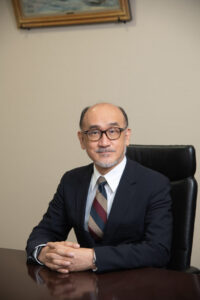
Kazumi Sakai is Professor Emeritus at Keio University. Since 2022, he has been teaching German as a foreign language and German teacher education courses as a specially-appointed professor at Dokkyo University. He has studied German language and literature, western philosophy and history of arts in Tokyo, Münster and Berlin. His research interests include plurilingualism, language policy, teacher training, and educational technology.
He has served for decades as an executive member of the Japanese Society for German Literature and two terms as president of the Japanese German Teachers Association. He is also a founding executive member of the Japan Council on the Teaching of Foreign Languages (JACTFL) and the editor-in-chief of its journal.
Recent works include: K. Sakai et al. (2022) Gaikokugo kyoiku o kaeru tame ni (Towards Changing Foreign Language Education in Japan), Sanshusha; K. Sakai et al. (2018) Kotoba o oshieru, kotoba o manabu: Fuku-gengo, fuku-bunka, CEFR to gengo kyōiku (Teaching and Learning Languages: Plurilingualism, Pluriculturalism, CEFR, and Language Education), Kōrosha.
Naoko Taguchi
Northern Arizona University

Naoko Taguchi is Professor of Applied Linguistics at Northern Arizona University where she teaches courses in TESOL and linguistics. Her research interests include second language pragmatics, technology-enhanced language learning, and intercultural communication. Her recent book publications include The Encyclopedia of Applied Linguistics Pragmatics Volume (co-edited with Daniel Kadar, in press) and Teaching and Learning Pragmatics in the Globalized World (special issue with the Modern Language Journal, 2021). She is currently the co-editor of Language Learning (Wiley) and Applied Pragmatics (John Benjamins). She also serves on the editorial/advisory board for 12 journals and book series.
Shoko Sasayama
Waseda University, Tokyo

Dr. Shoko Sasayama (Ph.D., Georgetown University) is an Associate Professor at Waseda University, where she teaches Applied Linguistics courses and manages a college-wide English language program. Prior to joining Waseda, she worked as a researcher at ETS and as a professor at the University of Tokyo. Her research mainly focuses on second language acquisition, task-based language teaching, and assessment. She is a strong advocate for the use of research for improving L2 education in Japan and beyond.
Masato Kaneko 金子 正人
Yokohama City Minami Yoshida Elementary School 横浜市立南吉田小学校

横浜市立南吉田小学校校長
95年から3年間台北日本人学校勤務。文科省「JSLカリキュラムの開発に係る協力者会議」委員。その後教育委員会事務局やこども青少年局勤務を経て現職。
学校ホームページ https://www.edu.city.yokohama.lg.jp/school/es/minamiyoshida/
Theme Featured Panel Discussion
Language Revitalization: Ainu, Southern Ryukyuan, Māori, and Welsh languages
Sunday, November 2nd, 2025 at 3PM (Large Hall)
Co-sponsored by the Hokkaido Chapter and Bilingualism SIG
Moderators: Maria Gabriela Schmidt and Anton Potgieter
This panel emphasizes languageS classified as heritage, minority or ethnic endangered languages. The panelists will outline the emergence and emerging efforts on revitalization of Welsh as a success story, Southern Ryukyuan as a live multilingually challenge and the mutual support of Maori and Ainu.
Dr. Kathryn Jones
Focus: Revitalizing Welsh

Kathryn is a director at IAITH: Welsh Centre for Language Planning. She began her career as a TESOL, TEFL and EAP teacher, working in London, Paris, Beijing and Lancaster. Kathryn holds an MA in Language Studies and a PhD in Sociolinguistics. Since 1999, she has led IAITH’s research and consultancy work focusing on education, early language socialisation, and the language revitalisation of Welsh and other minoritised languages.
Workshop Title: Wales: Towards pedagogies for learning and belonging
This workshop will be an opportunity to reflect upon teaching approaches and techniques that deepen learning, develop belonging and acknowledge learners’ cultural and linguistic diversity. I’ll present information about the role of education in current Welsh language revitalisation efforts in Wales and share examples of new developments in Welsh language teaching for children, young people and adults of differing linguistic and cultural backgrounds. Together, we’ll share and reflect upon common challenges and new ideas.
Dr. Sachiyo Fujita-Round
Focus: Ryukyuan and Revitalization

Sachiyo FUJITA-ROUND is a Specially Appointed Associate Professor at Daito Bunka University. She is a sociolinguist and has studied bilingualism in childhood for three decades. Since 2012, she has conducted fieldwork in the Miyako Islands, investigating Japanese-Miyakoan bilingualism. Her paper, ’Language Revitalization and Classroom,’ appeared in “Languages” in 2023. She has collaborated on filming and documenting language speakers in Southern Ryukyus to inform the endangered languages in Japan on the YouTube page “Live Multilingually Project”.
Workshop Title: Ryukyu languages and Revitalization
In this workshop, the presenter aims to offer an experiential journey to ‘language endangerment in Japan’ and discuss together the future of revitalising such languages. As a starting point, we will watch the documentary film “The Future of Miyaakufutsu (Miyakoan Language): Vanishing Voices, Emerging Voices” (47 minutes, 2019), filmed by the presenter and features the people and language of Miyako Islands. This encompasses the nuanced Japanese modernisation and language education policy of the Meiji Era.
Matthew Cotter
Maori and Ainu – Mutual support and Revitalization

Matthew Cotter is an associate professor at Hokusei Gakuen University in Sapporo, Japan. Of Maori descent, he began his career as a primary school teacher in Aotearoa New Zealand before moving to Japan in 1999. He holds degrees in Māori Studies and Psychology and also has an M.Ed. with a specialization in TESOL. His research interests include international virtual exchange (IVE), computer-assisted language learning (CALL), and support for indigenous culture and language revitalization.
Workshop Title: Māori Haka: Cultural Understanding Through Māori Haka Performance
This workshop will focus on cultural understanding by learning about the cultural rules, intentions and meaning surrounding Māori haka. We will begin with a short lecture on the what, when and why for performing a haka and also the history of one particular haka. Participants will learn the meaning of the words and actions, and finally perform a haka together. Come prepared to move, stamp your feet and make some noise!