Michinoku English Education Summit (MEES) 2026
June 27 @ 11:00 AM – 4:00 PM

Venue: Hachinohe Gakuin University – Hachinohe Art Museum Satellite Space, Hachinohe, Aomori
MEES is a friendly and supportive professional development environment that welcomes participants from all regions and language teaching practices. We encourage novice presenters and those from non-academic backgrounds.
Conference Theme:
“Practical EFL Tips, Tools, and Techniques”
We welcome any proposals with relevance to language teaching and learning for any age group within the English as a Foreign Language context. Submissions may include action research conducted inside or outside the classroom, works in progress, teaching strategies and pedagogy, pilot studies, as well as proposals for discussion sessions and workshops.
Sessions are set at 30 minutes (including questions). Please advise us on your session format: formal presentation, workshop, discussion, or demonstration. Also, if you would like more than 30 minutes, or have any other questions regarding presenting, let us know.
Abstract Submissions: Abstract must be no longer than 300 words in English, in either MS Word, Mac Pages, or PDF file.
Send all abstract submissions to: MEESjapan@gmail.com
Proposal Abstract Deadline: Monday, March 30th, 2026.
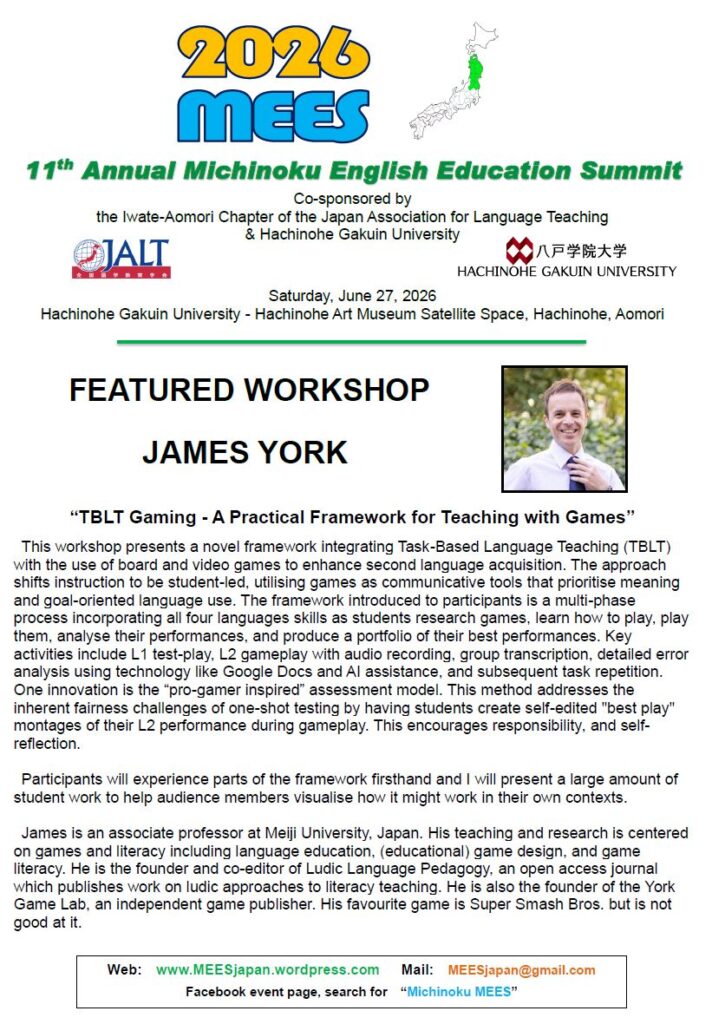
MEES FEATURED WORKSHOP
JAMES YORK
“TBLT Gaming – A Practical Framework for Teaching with Games”
This workshop presents a novel framework integrating Task-Based Language Teaching (TBLT) with the use of board and video games to enhance second language acquisition. The approach shifts instruction to be student-led, utilising games as communicative tools that prioritise meaning and goal-oriented language use. The framework introduced to participants is a multi-phase process incorporating all four languages skills as students research games, learn how to play, play them, analyse their performances, and produce a portfolio of their best performances. Key activities include L1 test-play, L2 gameplay with audio recording, group transcription, detailed error analysis using technology like Google Docs and AI assistance, and subsequent task repetition. One innovation is the “pro-gamer inspired” assessment model. This method addresses the inherent fairness challenges of one-shot testing by having students create self-edited “best play” montages of their L2 performance during gameplay. This encourages responsibility, and self-reflection.
Participants will experience parts of the framework firsthand and I will present a large amount of student work to help audience members visualise how it might work in their own contexts.
James is an associate professor at Meiji University, Japan. His teaching and research is centered on games and literacy including language education, (educational) game design, and game literacy. He is the founder and co-editor of Ludic Language Pedagogy, an open access journal which publishes work on ludic approaches to literacy teaching. He is also the founder of the York Game Lab, an independent game publisher. His favourite game is Super Smash Bros. but is not good at it.